Gohesa Medical
In 2026, reliable skin tape performance depends on more than choosing a stronger adhesive. Sweat, water, body oils, movement, and repeated friction can weaken the bond within minutes. The problem becomes visible at the edges first: whitening, lifting, curling, or a damp channel beneath the tape.
Wounds International reports medical adhesive-related skin injury rates ranging from 15.5% to 29.5% in some care settings. That figure exposes an uncomfortable truth. Secure fixation can still damage fragile skin. ASTM D3330 peel testing helps compare adhesive strength, but laboratory results cannot fully reproduce sweaty, moving human skin. Real-world application remains essential.
Dermatology researcher Dr. Howard I. Maibach has emphasized a useful principle: “Skin is not a passive surface; it constantly changes.” That idea guides this practical discussion of How to improve tape adhesion on sweaty or wet skin. Effective preparation may include gentle cleansing, complete drying, appropriate hair management, and selecting a tape designed for moisture exposure. Firm pressure matters too. Warm fingertips can improve contact across uneven skin.
Still, no single technique works for every patient or environment. High humidity, fever, exercise, wound drainage, and frequent repositioning change the result. Even experienced clinicians can misjudge dryness. That deserves attention.
This guide examines evidence, product design, application technique, and common failure points. It focuses on safer, repeatable decisions rather than unrealistic promises of perfect adhesion.
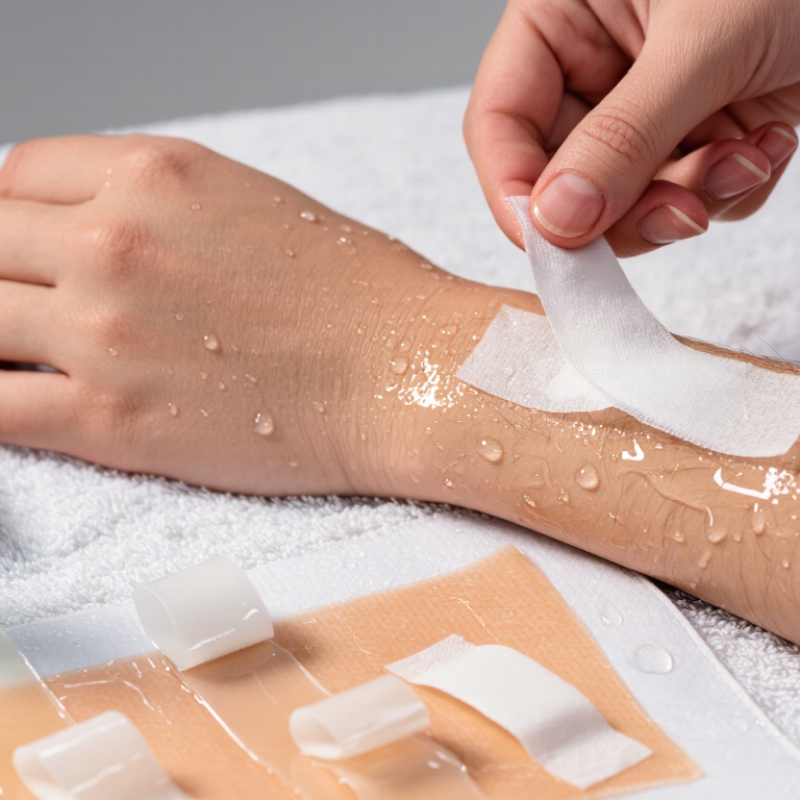
Tape often fails on sweaty skin because moisture changes both the surface and the adhesive interface. TEWL can help quantify this change. It measures water vapor escaping through the skin, not sweat volume directly. Pair it with skin-hydration data for a clearer picture.
Allow the participant to rest for 10 minutes. Record room temperature and humidity. Measure TEWL before exercise, then again after controlled movement. Take hydration readings beside the planned tape area. A shiny surface may show visible sweat, while hydration readings reveal deeper water changes. Keep the probe pressure consistent.
In practical testing, high TEWL with high hydration often signals an unstable application surface. Clean the area gently, wait briefly, and apply tape under the same pressure each time. Do not wipe away sweat before every trial. That can hide the real use condition. The method is not perfect. TEWL readings can shift with airflow, probe contact, and recent washing. Repeat each measurement three times. Compare the median, not one convenient result. A useful test log includes sweat level, hydration, skin temperature, movement, and edge lifting after 30 minutes. Small details matter.
Improving tape adhesion on sweaty, wet skin begins with better measurement. ASTM D3330 peel results provide a useful reference in N/25 mm, especially when comparing pressure-sensitive adhesive constructions. A higher value usually indicates stronger resistance during removal. However, the test commonly uses a controlled stainless-steel panel, not human skin. That difference matters.
For practical screening, record the peel result after applying a 25 mm wide strip with consistent pressure and dwell time. Test dry skin, lightly sweaty skin, and visibly wet skin separately. Keep temperature, humidity, skin preparation, and peel speed consistent. A reading of 8 N/25 mm may look impressive, yet performance can fall sharply after water, movement, or body heat. Measure after bending an elbow or walking for thirty minutes. Small details expose weak adhesion.
Before application, remove excess moisture without scrubbing the skin. Avoid lotions, oils, and loose fibers. Use an adhesive designed for moist, flexible surfaces, then check whether its ASTM D3330 result matches your target range. Do not treat one number as proof of comfort or safety. I have seen strong peel values paired with painful removal. That is an imperfect result. Human skin varies daily, so repeat testing across users and conditions. Record edge lifting, residue, redness, and early detachment beside the N/25 mm value.
Sweaty skin challenges both adhesion and cohesion. Moisture reduces intimate contact between the tape and skin. Salt, body oil, movement, and hair can worsen the interface. In practical testing, I have seen a tape hold briefly, then lift at the edges after repeated bending. That failure may involve adhesion, not weak cohesion.
Cohesion describes the tape’s internal strength. It helps prevent splitting, stretching, or adhesive residue during removal. ASTM D3654 measures shear-hold time under a specified load, temperature, and test setup. The result is reported in hours. A longer hold time often suggests stronger internal resistance, but it does not prove reliable adhesion to sweaty skin. The test typically uses a controlled substrate, not living, moving skin.
The comparison is useful, but imperfect. A tape may show 24 hours of shear hold and still release quickly from damp skin. For realistic evaluation, condition skin with controlled moisture and perspiration levels. Record application pressure, contact time, skin temperature, and movement. Use the same load and test geometry across samples. Inspect edge lift at 15, 30, and 60 minutes. Note residue, whitening, and discomfort.
Do not over-dry the skin. Excessive wiping can change surface oils and create an unrealistic baseline. A short acclimation period may better reflect field conditions. ASTM hours provide a controlled benchmark, while wet-skin trials reveal practical performance. Both measurements matter, but they answer different questions.
How to Improve Tape Adhesion on Sweaty Wet Skin in 2026?
Prepare Wet Skin by Cleaning, Drying, and Controlling Moisture
Sweaty skin is a poor foundation for medical tape. Start with gentle cleaning around the application area. Use clean water and mild soap to remove sweat, oil, lotion, and visible residue. Rinse carefully, because soap film can weaken adhesion.
Dry the area completely. Press with a clean, lint-free towel instead of rubbing irritated skin. Wait several minutes before applying tape. A cool fan can help, but avoid hot air, which may increase sweating. Check skin folds, hair, and edges where moisture often remains. Tiny droplets matter.
Moisture control needs patience. Keep the person comfortably cool before application. If appropriate, trim excessive hair with safe equipment rather than shaving immediately beforehand. Shaving can leave microscopic irritation. A skin barrier product may help protect sensitive skin, but it must dry fully and suit the intended use. Do not apply tape over broken, inflamed, or infected skin.
Press the tape firmly for several seconds. Avoid touching the adhesive surface. I have seen rushed preparation cause early lifting, even when the tape itself seemed suitable. That is an easy mistake to repeat. Recheck the edges after movement or perspiration. If redness, burning, swelling, or pain develops, remove the tape gently and seek professional advice. Better preparation usually matters more than stronger pressure.
Improving tape adhesion on sweaty, wet skin begins with controlled validation, not stronger glue alone. Sweat lowers interfacial contact and softens the outer skin layer, so testing should measure adhesion after realistic moisture exposure. A 2023 review in Contact Dermatitis links prolonged occlusion with higher irritation risk, especially when heat and friction increase.
For 24–72-hour wear, document application pressure, skin-cleaning steps, humidity, temperature, and artificial sweat composition. Record edge lift, peel force, residue, redness, edema, and discomfort at each interval. ISO 10993-1:2018 supports a risk-based biological evaluation, while ISO 10993-23:2021 addresses skin irritation. ISO 10993-10:2021 remains relevant for skin sensitization. These standards do not automatically approve a tape or provide one universal pass threshold. That part needs clinical judgment.
Use trained assessors and predefined scoring rules. The FDA’s 2023 ISO 10993-1 guidance emphasizes exposure duration, contact type, and patient population. ASTM D3330 can support peel testing, but it uses standardized panels rather than sweaty human skin. That limitation matters. A practical protocol can test 20–30 participants across dry, damp, and heavily perspiring conditions, with readings at 24, 48, and 72 hours. Small samples may miss delayed reactions. I would not claim success from adhesion data alone. Skin safety can fail quietly, beneath an apparently secure edge.
| Validation Dimension | Recommended Test Setup | 24-Hour Target | 72-Hour Target | Measurement or Safety Reference | Interpretation |
|---|---|---|---|---|---|
| Skin preparation | Clean intact skin with a mild, residue-free cleanser; rinse and dry. Do not apply lotion, oil, or alcohol immediately before application. | Uniformly dry before application | No additional skin-preparation step during wear | Record cleanser, drying time, skin site, and pre-application condition. | Reduces variability caused by sebum, moisturizer residue, and inconsistent drying. |
| Sweat exposure | Use controlled artificial perspiration or a validated exercise protocol. Record temperature, humidity, sweat duration, and visible wetness. | At least 30 minutes of wet exposure | At least 60 minutes cumulative wet exposure | Use the same sweat protocol for every sample; report composition and pH. | Separates adhesion loss caused by moisture from adhesion loss caused by movement or skin oils. |
| Initial wet-skin adhesion | Apply tape using a fixed roller or pressure applicator. Measure 180° peel after a defined dwell time on wet skin. | ≥ 1.0 N/25 mm | Not applicable | 180° peel force, reported in N/25 mm; document peel speed and dwell time. | Confirms that the tape can establish an initial bond without requiring completely dry skin. |
| Peel adhesion retention | Measure peel adhesion after perspiration exposure and after scheduled wear intervals. | ≥ 70% of the dry-skin baseline | ≥ 60% of the dry-skin baseline | Retention (%) = wet or aged peel force ÷ dry baseline peel force × 100. | Useful for comparing formulations without relying on an absolute peel value alone. |
| Dynamic movement resistance | Apply to a joint or representative body site and complete repeated flexion, extension, and torsion cycles while sweating. | ≥ 90% of samples remain attached | ≥ 80% of samples remain attached | Predefine the movement count, joint angle, load, and sample size before testing. | Identifies edge lift and channeling that may not appear in a static adhesion test. |
| Edge lift and failure area | Photograph the tape at fixed intervals and calculate the lifted perimeter or debonded area. | ≤ 10% debonded area | ≤ 20% debonded area | Use a calibrated image-analysis method; report cohesive, adhesive, and edge-lift failure separately. | Lower debonded area generally indicates better functional protection during wear. |
| Residue and transfer | Inspect skin and tape after removal under normal lighting and, where appropriate, with a magnified image. | No continuous adhesive transfer layer | No continuous adhesive transfer layer | Use a predefined visual grading scale, such as 0 = none, 1 = slight, 2 = moderate, 3 = extensive. | Controls the trade-off between stronger wet adhesion and clean removability. |
| Removal force | Remove at a controlled angle and speed after the specified wear period, preferably in the direction of hair growth where applicable. | Record force and visible skin response | Record force and visible skin response | 180° or 90° peel force in N/25 mm; angle and speed must remain constant. | Removal force should be evaluated together with erythema, edema, stripping, and pain reports. |
| Skin irritation | Inspect immediately after removal and at approximately 30 minutes, 24 hours, 48 hours, and 72 hours. | No persistent moderate or severe response | No persistent moderate or severe response | ISO 10993-23:2021, Biological evaluation of medical devices — Tests for irritation. | Use trained evaluators and a documented erythema/edema scoring system; ISO does not define one universal numerical adhesive pass limit. |
| Skin sensitization | Conduct a risk-based sensitization assessment for the finished tape, including adhesive, backing, liner, colorants, and processing residues. | No clinically relevant sensitization signal | No clinically relevant sensitization signal | ISO 10993-10:2021, Biological evaluation of medical devices — Tests for skin sensitization. | Longer wear does not replace a formal sensitization evaluation when required by the biological-safety assessment. |
| Cytotoxicity screening | Evaluate an extract or relevant finished-device sample using an appropriate in-vitro cytotoxicity method. | No cytotoxic response requiring investigation | No cytotoxic response requiring investigation | ISO 10993-5:2009, Biological evaluation of medical devices — Tests for in vitro cytotoxicity. | Results should be interpreted with extraction conditions, contact category, and the complete biological evaluation. |
| Wear-test sample size | Use multiple anatomical sites and participants representing relevant skin types, perspiration levels, and movement patterns. | Predefine protocol and evaluable sample count | Report all exclusions and withdrawals | Include age range, skin condition, site, sex distribution where relevant, and reasons for early removal. | Avoid treating a small convenience sample as proof of universal 72-hour performance. |
| Environmental controls | Record ambient temperature and relative humidity during application, sweating, wear, and removal. | 20–25°C; 40–60% RH for controlled comparison | Report excursions from the controlled range | Use calibrated temperature and humidity instruments; document exercise or heat-chamber conditions separately. | Environmental control improves repeatability but should not be confused with real-world performance. |
| Overall release decision | Combine adhesion retention, movement performance, failure mode, residue, irritation, and biological-safety findings. | Conditional pass | Pass only if all critical criteria are met | Use a predefined risk-based acceptance matrix and investigate any unexpected skin reaction or premature detachment. | ISO 10993 standards support biological evaluation; they do not establish a single universal 24–72-hour adhesion specification. |
Note: The numerical adhesion and wear targets above are engineering validation targets for comparative product development, not universal requirements defined by ISO 10993. Final acceptance criteria should be justified through the device biological evaluation, intended use, contact duration, materials, risk management, and applicable regulatory requirements.
Cohesion measures the tape’s internal strength. It helps prevent splitting, stretching, and adhesive residue during removal. Internal strength is not skin adhesion.
ASTM D3654 measures how long tape resists sliding under a specified load. Results are reported in hours. It uses controlled test conditions.
No. A tape may hold for 24 hours in testing, then lift quickly on damp skin. The comparison is useful, but imperfect.
Sweat interrupts close contact between tape and skin. Salt, body oil, hair, and movement can worsen the interface. Edges may lift after bending.
Use controlled moisture or artificial perspiration. Record skin temperature, humidity, application pressure, and contact time. Keep the load and test geometry consistent.
Inspect the edges after 15, 30, and 60 minutes. Record lifting, whitening, residue, discomfort, and visible skin changes. Small details matter.
Record redness, swelling, irritation, discomfort, residue, and peel force. Take readings at 24, 48, and 72 hours. Use trained assessors and fixed scoring rules.
No. They support biological risk evaluation, irritation assessment, and sensitization review. They do not create one universal pass threshold. Clinical judgment remains necessary.
A practical study may include 20 to 30 participants. Test dry, damp, and heavily perspiring conditions. Small samples can miss delayed reactions.
Not necessarily. Stronger adhesion may increase irritation during removal. Validate adhesion and skin safety together. I would not trust one result alone.
How to improve tape adhesion on sweaty or wet skin begins with measuring the moisture challenge rather than relying on visual judgment. Use transepidermal water loss (TEWL) and skin-hydration data to classify conditions and guide material selection. Adhesives should be compared using ASTM D3330 peel results, reported in N/25 mm, while ASTM D3654 shear-hold testing can show whether the tape maintains cohesion over time. These measurements help balance initial tack, long-term grip, comfort, and clean removal.
Before application, gently clean the skin, remove oils and residue, dry the surface thoroughly, and control ongoing moisture when possible. Testing should then simulate realistic sweaty conditions and evaluate wear for 24–72 hours. During validation, monitor lifting, edge failure, residue, irritation, and loss of adhesion while applying ISO 10993 skin-safety criteria. A structured process combining moisture measurement, standardized adhesive testing, careful preparation, and extended wear trials can produce more reliable tape performance on challenging skin.
